
Professor Howard visited Knole many times over six decades. In the years 2007 to 2010/11, he supervised one doctoral student, Alden Gregory, whose work provided revelations about how the Archbishops of Canterbury (Bourchier, Warham and Cranmer) lived at Knole, extending parts of it during their time. A second student, Ed Town’s work delved into the 1st Earl of Dorset’s life at Knole after he bought it in and created a legacy which lives on through the Sackville-West family and the National Trust.
Maurice Howard, OBE, supervised two key PhD theses on Knole
Emeritus Professor of Art History, University of Sussex; architectural historian
Interviewed by Veronica Walker-Smith in 2022
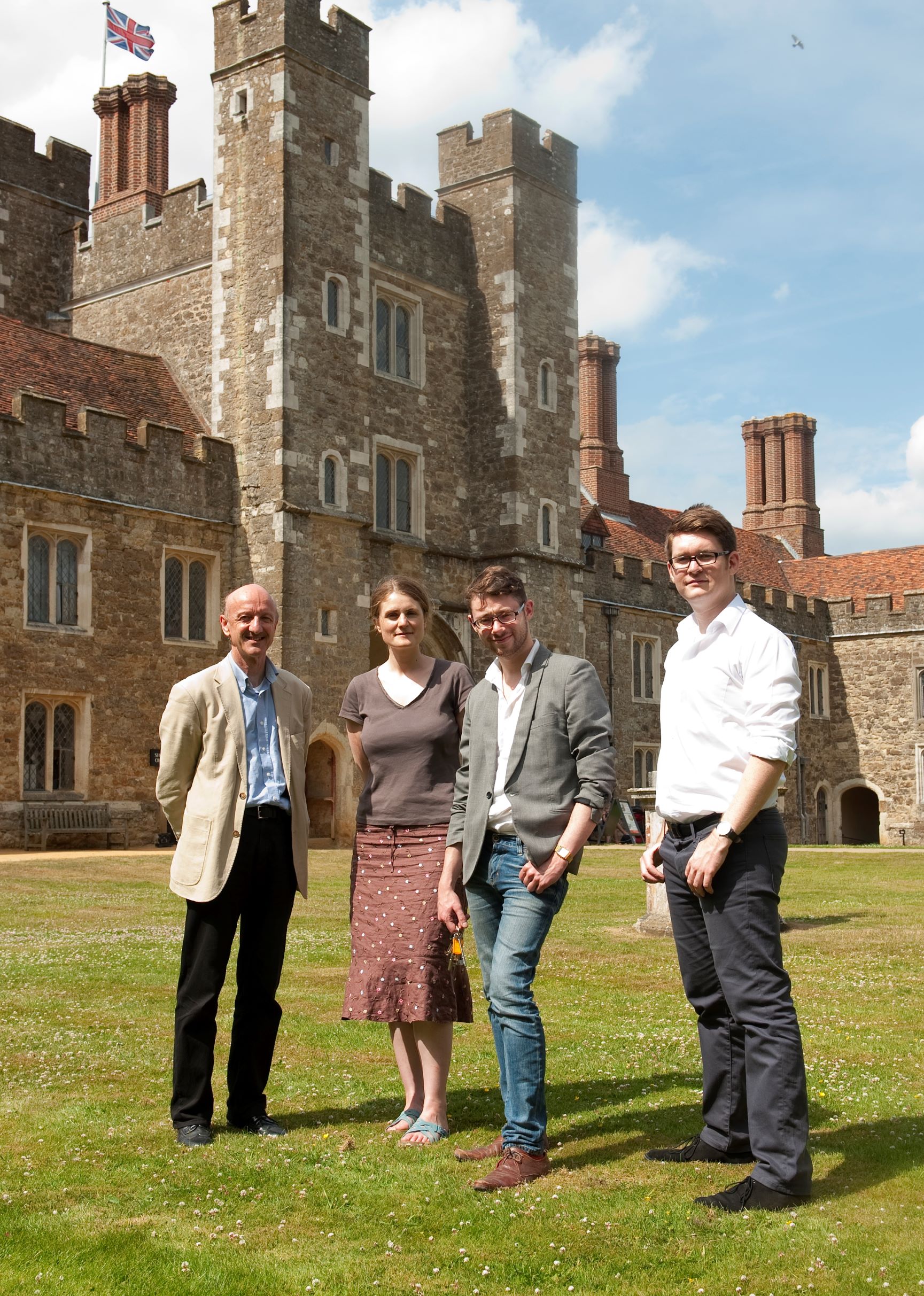
L-R: PhD theses supervisor Maurice Howard, Emma Slocombe (Knole Project Curator), Ed Town (researcher on 1st Earl of Dorset), Alden Gregory (researcher on archiepiscopal building work at Knole)
Stuart Robinson
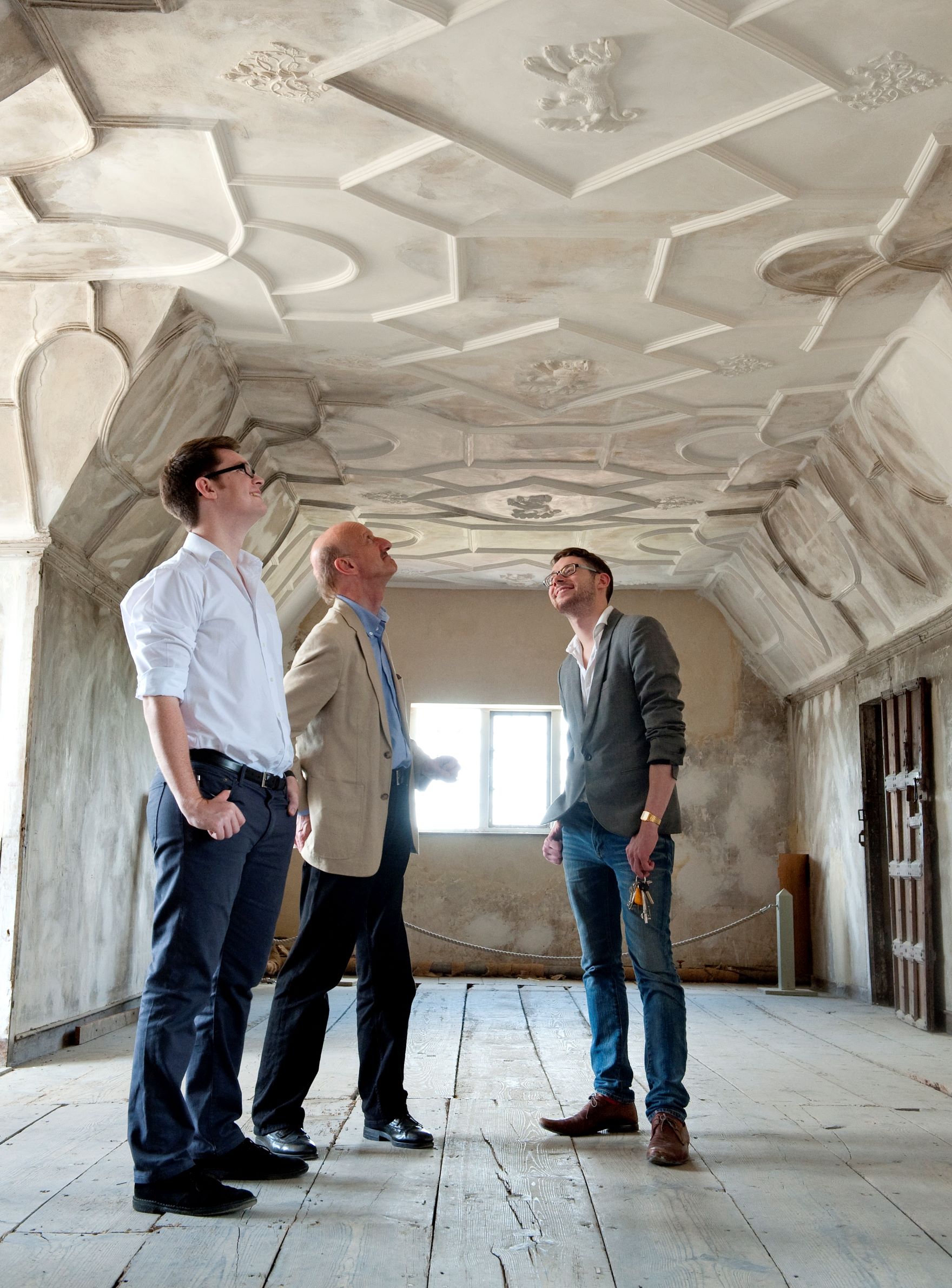
Maurice with his doctoral students Alden Gregory and Ed Town in the Retainers Gallery in 2010
Stuart Robinson
Background to 21st century PhD research on Knole, supervised by Maurice
M.H.: People hadn’t really come to grips with what was the sequence of building: maybe Henry VIII built this range, maybe he didn’t. So, it was the work that Ed and Alden were able to do, through their documentary researches at the National Archives, at Lambeth [Palace] the Archbishop of Canterbury’s archives, and of course at Maidstone [Kent History and Library Centre] and other places, to really unpick that. And also, I think they were key, with other staff working here now, in encouraging the National Trust to have some forensic, some larger-scale bits of archaeology done during that time. So, the Oxford Archaeological group were here during their time, and slowly they were able to put together new building sequences, which have inspired and led the Trust’s view of other work that needs to be done ever since.
Their PhDs were important templates and foundation stones for the great project [Inspired by Knole, 2013-2019 ] the Trust has recently undertaken. And work that will go forward into the future.
Alden Gregory's research approach on the Archbishops who built and lived at Knole
What was very interesting about the ways in which they approached it: for Alden, of course, there’s limited documentation and so what he did was look at the Household Ordinances of Archbishop Cranmer, of his life in other palaces and move that back towards the way Knole might have been operating under Bourchier and Warham who were the two chief and most significant Archbishops of Canterbury who built here. Cranmer was only here for really a very short time.
So, he [Alden] had to apply things about, you had to think about the ceremonial life of an Archbishop, you had to think about worship in these buildings, you had to think about procession from one place to another. And thinking about how Knole might have worked in its smaller state before outer courts were built in the 16th century and other things were done; how an Archbishop would have held court here.
Ed Town's research approach
M.H.: Ed Town really focused on the life and patronage of the 1st Earl [of Dorset], of Thomas Sackville. He looked at his multiple houses and his commitments. He discovered a lot about Lord’s Place in Lewes, for example, and so was giving us a picture of Thomas Sackville’s world view over a long period working for the government. And then this sense that, as it happened at the very end of his life, this really very dramatic and wonderful period at Knole wherein in those few years, he has this new internal palace built. It’s not entirely reflected externally but there’s a loggia, but not a lot else that we can see. But inside, it’s like a grand house and replicates to some extent the grand London houses being built at this period.
But what was always interesting to me was that this new sequence of apartments is being fitted in to something which I recognize from a century before: big rambling courtyard houses, how that was done. Ed looked at Thomas’s travels in France and Italy, his poetry, to try and get a sense of the cultural world which he lived in and recognized and found many new documents. His contribution was to particularly identifying, as Alden had formulated in our minds much more precisely, the masons and carpenters of the 15th and early 16th century. So, Ed also looked at all these internal decorators.
Time period
This page was added by Veronica Walker-Smith on 14/02/2025.

No Comments
Add a comment about this page